Feeling Like Roommates? Why Busy Couples Drift Apart
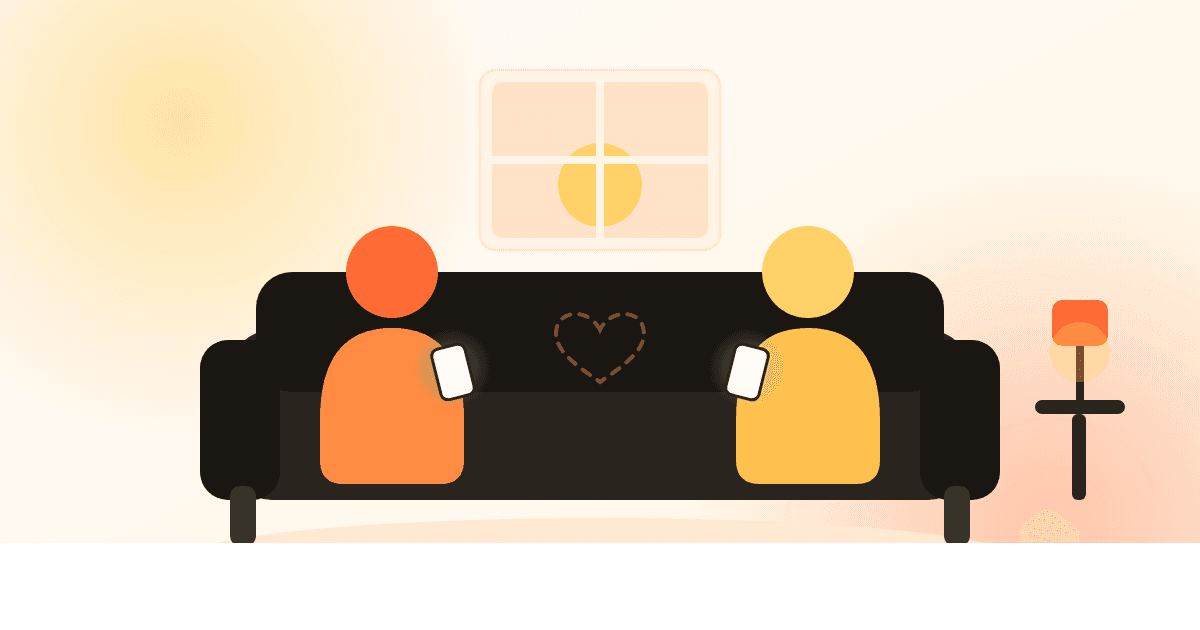
You still love each other. Nobody did anything wrong. And yet somewhere between the deadlines, the school runs, and the life admin, you started feeling less like partners and more like well-organized roommates. If that sentence stings a little, this article is for you — because what you're experiencing has a name, a cause, and a fix.
What is the “roommate phase”?
The roommate phase is the stage in a long-term relationship where day-to-day interactions become almost entirely logistical — who picks up groceries, who handles the plumber, who takes the early meeting — while moments of genuine connection quietly disappear. You cooperate well. You may rarely fight. But you talk like colleagues running a small household company, not like two people who chose each other.
It matters because the roommate phase is often invisible from the inside. There's no crisis to point to. Both partners are trying hard — usually at work, at parenting, at keeping life running. The relationship isn't broken; it's just running on autopilot, and autopilot only flies in one direction: apart.
Why do couples drift apart?
Drift is rarely caused by one event. It's the compound result of two forces that affect almost every couple between 30 and 50:
- Time scarcity. Between demanding jobs, kids or caring responsibilities, and basic life maintenance, discretionary time shrinks to almost zero. Connection stops getting scheduled — because it never needed scheduling before.
- Habit erosion. Early in a relationship, connection habits are automatic: long conversations, constant messages, undivided attention. Nobody decides to stop them. They just erode, one busy week at a time, until the default day contains zero intentional moments of connection.
- The compounding effect. Missing one good-night conversation costs nothing. Missing three hundred costs a lot. Like interest on a loan, disconnection accrues silently — you only notice the balance when it's already large.
- Asymmetric energy. Often one partner notices the drift first and pushes for change while the other — equally loving, just more depleted — can't match the effort. The gap breeds resentment on one side and guilt on the other, which accelerates the drift.
Nobody decides to drift apart. It's what happens when nobody decides anything at all.
7 signs you're on relationship autopilot
Every couple is different — married or not, kids or no kids, same city or juggling travel — but autopilot looks remarkably similar across all of them:
- Your conversations are 90% logistics. Schedules, chores, money, kids — and almost nothing about inner lives.
- Physical affection has become a greeting. A peck on the cheek that could be exchanged with a distant relative.
- You know their calendar, not their mind. You could recite your partner's meetings but couldn't say what they're worried about this week.
- Phones win the evening. You're on the same sofa, in separate digital worlds, most nights.
- “How was your day?” gets a one-word answer — and neither of you follows up.
- You feel guilt more often than longing. You know you should reconnect, and the knowing feels heavy rather than exciting.
- Big efforts feel exhausting to imagine. A weekend away or a fancy dinner sounds like another project to manage, not a joy.
If you recognized your relationship in three or more of these, you're in drift. And it's worth saying clearly: so are millions of loving couples. Take Maya and Sofia — two careers, a toddler, aging parents. Or Daniel and Priya, who moved cities for work and lost every routine they had. None of them stopped loving each other. They just ran out of the spare capacity that connection used to live on.
Why drift is nobody's fault
The most damaging myth about relationship drift is that it signals a defect — in you, your partner, or the relationship. The evidence points the other way: drift is the default outcome of modern life applied to any relationship, the same way physical de-conditioning is the default outcome of a desk job. It isn't a character verdict. It's an environment problem.
That reframe matters practically, because guilt is a terrible fuel for change. Couples who treat drift as a shared, no-fault engineering problem (“our system stopped working — let's fix the system”) consistently do better than couples who treat it as a blame question (“why did you stop trying?”).
How do you reverse relationship drift?
Here's the hopeful part: drift is symmetrical. The exact mechanism that caused it — small moments, compounding daily — also reverses it. You don't need a dramatic reset. You need to reinstall a handful of tiny, daily connection habits that fit inside a busy life instead of competing with it:
- A good-morning message that says something real, not just “morning.”
- One shared gratitude at dinner — a single sentence each.
- A two-question check-in before sleep: best part of your day, and anything heavy?
Five minutes a day, total. It sounds almost insultingly small against a problem this heavy — which is exactly why it works. Small enough to survive your worst week is the entire secret. We unpack the science of why tiny beats big in our guide to micro-habits for couples, and why the obvious alternative — trying harder with date nights and grand gestures — usually backfires.
Next in this series: if daily habits are the cure, why does everyone prescribe date nights? We break down why date nights don't fix relationship drift — and what to do instead.
Frequently asked questions
Is it normal to feel like roommates with your partner?
Yes — extremely. Relationship researchers consider "roommate phase" drift one of the most common experiences in long-term relationships, especially for couples aged 30–50 juggling demanding jobs and kids. It is a byproduct of time scarcity and eroded daily rituals, not proof that love is gone.
Does drifting apart mean the relationship is over?
No. Drift is a pattern, not a verdict. Because it is caused by the slow disappearance of small daily connection habits, it is usually reversible the same way it happened: through small daily actions, consistently repeated — not through one dramatic fix.
How long does it take to reconnect after drifting apart?
Most couples notice a shift within two to four weeks of consistent daily micro-connection — a genuine good-morning text, a 5-minute evening check-in, one shared gratitude a day. The key variable is consistency, not intensity.
When should we seek couples therapy instead?
If there is contempt, chronic conflict, betrayal, or one partner has emotionally checked out entirely, professional support is the right tool. Daily habits are powerful for drift — the slow fade of busy but loving couples — not for crisis.